
How To
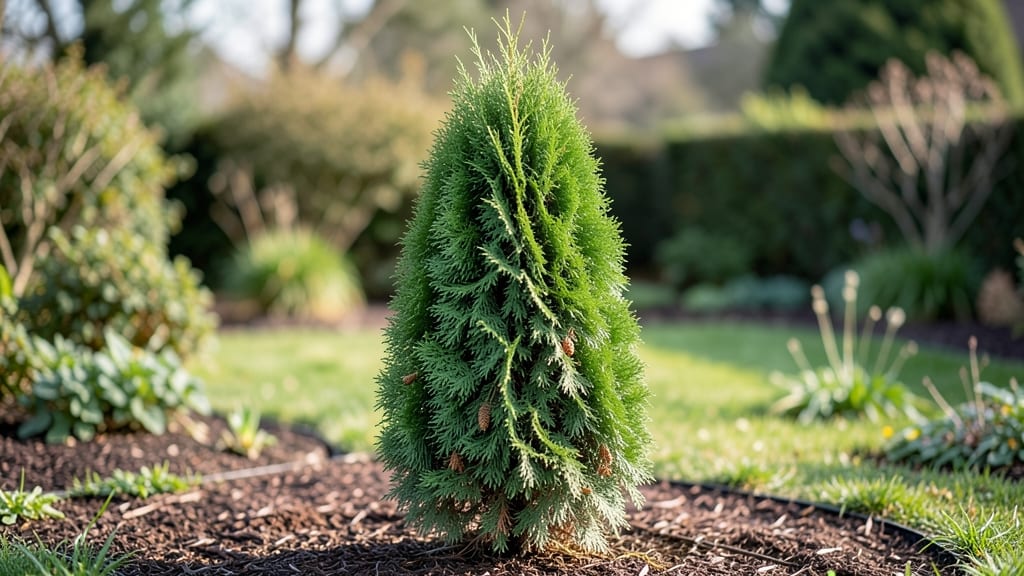
If you're planning to add an Emerald Green Arborvitae 🌲 to your landscape, you're probably wondering just how tall this classic evergreen will grow—and whether it’ll fit perfectly in your space. The answer isn’t one-size-fits-all, but with the right spacing and care, you can predict its height with surprising accuracy.
This popular shrub typically matures between 12 and 15 feet, but its growth rate varies dramatically in the first few years. In its first year, you’ll see just 1 to 2 feet of growth, while by year three, it can shoot up to 5 to 7 feet.
Understanding this progression helps you plan for long-term spacing and maintenance.
What many gardeners don’t realize is that proper planting distance—usually 3 to 6 feet apart—plays a huge role in controlling its final height. Too little space can lead to competition, stunting growth, while too much gives it room to reach its full potential.
Let’s break down the exact growth stages and spacing rules to help you visualize this shrub’s future in your yard.
Whether you’re creating a privacy screen or adding a focal point, knowing these details ensures your Emerald Green Arborvitae grows exactly as you envision. Ready to see how it fits into your landscape plans? Let’s dive into the numbers.


Emerald Green Arborvitae height by year: exact growth charts for mature and juvenile stages
If you're planning to add Emerald Green Arborvitae to your landscape, knowing its height progression helps you visualize its final form. This cultivar grows at a steady pace, reaching its mature height of 12–15 feet over 10–15 years.
The first few years are the most critical for establishing its structure, while growth slows significantly after year 5.
Under ideal conditions—full sun exposure, well-draining soil, and consistent moisture—your Emerald Green Arborvitae will follow a predictable growth curve. However, environmental stressors like poor drainage or limited sunlight can stunt its growth by 30–50%, leaving it shorter and less dense.
Let’s break down the year-by-year growth stages so you can set realistic expectations.
| Age (Years) | Height Range (Feet) | Growth Rate (Feet/Year) | Key Growth Notes |
|---|---|---|---|
| 1 | 1–2 ft | 1–2 ft | Rapid vertical growth; establish deep roots. |
| 2 | 3–4 ft | 1.5–2 ft | Branching begins; needs support in windy areas. |
| 3 | 5–7 ft | 1–2 ft | Foliage thickens; prune to encourage density. |
| 5 | 8–10 ft | 0.5–1 ft | Growth slows; focus on shaping. |
| 10 | 12–14 ft | 0.2–0.5 ft | Mature height reached; minimal vertical growth. |
| 15+ | 12–15 ft | 0–0.2 ft | Plateau phase; maintain with light pruning. |
During the first 3 years, your Emerald Green Arborvitae will grow the fastest, adding 1–2 feet per year. This is when its root system establishes deeply, giving it stability for its lifespan of 30+ years.
After year 5, growth tapers to just 0.2–0.5 feet annually, which is why many gardeners consider it a low-maintenance evergreen once mature.
For a hedge application, you’ll want to space plants 3–4 feet apart to allow their canopies to touch by year 5. If planting as a solitary specimen, give it 6–8 feet of clearance on all sides to prevent overcrowding.
Proper spacing isn’t just about aesthetics—it also reduces competition for nutrients and water, which can slow growth.
One common misconception is that Emerald Green Arborvitae will grow indefinitely. In reality, its height plateau occurs around 10–15 years, after which vertical growth becomes negligible.
However, if you notice unusually slow growth (e.g., less than 6 inches per year after year 3), check for root bound conditions, nutrient deficiencies, or pest damage like spider mites.
To encourage optimal growth, mulch around the base with 2–3 inches of organic mulch (like pine bark) to retain moisture and regulate soil temperature. Avoid over-mulching, as this can suffocate roots.
Pair this with a balanced fertilizer (10-10-10 NPK) applied in early spring every 2–3 years to support its foliage density.
If you’re comparing Emerald Green Arborvitae to other cultivars, it’s taller than American Arborvitae (which maxes out at 10–12 feet) but shorter than Green Giant (which can reach 30–40 feet). Its narrow, columnar shape makes it ideal for tight spaces, such as <
Optimal spacing rules to control Emerald Green Arborvitae height and shape
Your Emerald Green Arborvitae won’t just grow tall—it’ll grow wide and dense too, which is why spacing rules are non-negotiable. Planting too close can stifle airflow, inviting fungal diseases like canker, while spacing too far wastes space and slows hedge formation.
The sweet spot? 3–6 feet apart for single plants or hedges, depending on your goal.
For a privacy screen, space them 3 feet apart—this creates a tight, unbroken wall by year 5. But if you’re planting as individual accents, stretch them to 6 feet to prevent overcrowding and encourage upward growth.
Think of it like training for a marathon: proper spacing lets their roots compete for nutrients without smothering each other.
🌲
| Spacing Goal | Distance (ft) | Resulting Height | Best For |
|---|---|---|---|
| Tight Hedge | 3 feet | 12–14 ft (taller, narrower) | Privacy screens |
| Moderate Hedge | 4 feet | 13–15 ft (balanced) | Windbreaks |
| Individual Plants | 6 feet | 14–15 ft (full height) | Accent planting |
Soil compaction plays a sneaky role here. If your yard has clay-heavy soil, roots struggle to spread, forcing the plant to grow upward faster—sometimes adding an extra 2–3 feet to its height.
To counteract this, loosen the soil 12 inches deep before planting and mix in compost to improve drainage. This keeps growth predictable and your arborvitae looking lush, not leggy.
Pruning also shapes the outcome. If you shear annually (lightly!) in late spring, you’ll encourage a fuller, bushier shape and cap height at 12–14 feet. Skip pruning, and you might end up with a 15-foot tower that blocks sunlight for neighboring plants.
Think of pruning as a growth traffic cop—it directs energy where you want it.
Pro tip: Mulch heavily (3–4 inches of wood chips) around the base to retain moisture and suppress weeds. This reduces stress on the roots, which in turn keeps the plant focused on height control rather than fighting for survival.
Over time, this consistency pays off with a neater, healthier arborvitae that stays within your desired height range.
✂️